

Siracusa itinerary: 1 to 2 days
Plans for one and two days in Siracusa, day by day: Ortigia's Fountain of Arethusa, Castello Maniace, the Cathedral and the Temple of Apollo first, with the Greek Theatre, the Ear of Dionysius and the Roman Amphitheatre in the Neapolis park, then the Paolo Orsi Archaeological Museum, the Catacombs of San Giovanni, the Jewish ritual bath and Ortigia's palaces as you add a day. Every stop has a typical visit length.
How long do you have?
Map: 2 days
Siracusa in 1 day
Day 1

Ear of Dionysius
Tall, ear-shaped artificial cave in an ancient quarry of the Neapolis park, known for its echo.

Greek Theatre of Syracuse
Large 5th-century BC theatre cut into the rock of the Temenite hill, still used for classical plays each summer.

Roman Amphitheatre of Syracuse
Partly rock-cut Roman amphitheatre in the Neapolis park, once used for gladiator shows.

Temple of Apollo
Ruins of a 6th-century BC Doric temple at the entrance to Ortigia, among the oldest Greek temples in Sicily.

Ortigia Market
Lively morning street market near the Temple of Apollo, with fish, produce, cheese and street food stalls.
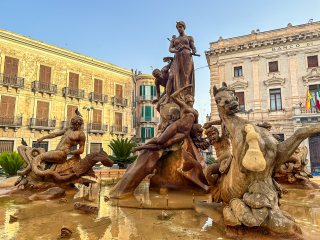
Fountain of Diana
Early 20th-century fountain on Piazza Archimede, Ortigia's main square, showing the goddess Diana and the nymph Arethusa.

Cathedral of Syracuse
Cathedral built into a Greek Doric temple of Athena, whose columns still line the nave, behind a Baroque facade.

Santa Lucia alla Badia
Baroque church on Piazza Duomo, home to Caravaggio's Burial of Saint Lucy, painted for Siracusa in 1608.

Castello Maniace
13th-century castle of Frederick II at the southern tip of Ortigia, with a vaulted hall and sea views.

Lungomare Alfeo
Ortigia's seafront promenade along the Ionian side, good for a walk by the old sea walls with views across the water.

Fountain of Arethusa
Freshwater spring on Ortigia's seafront where papyrus grows in a pool, linked in Greek myth to the nymph Arethusa.
Siracusa in 2 days
Day 1
Temple of Apollo
Ruins of a 6th-century BC Doric temple at the entrance to Ortigia, among the oldest Greek temples in Sicily.
Ortigia Market
Lively morning street market near the Temple of Apollo, with fish, produce, cheese and street food stalls.

Palazzo Montalto
Late 14th-century Gothic palace in Ortigia with fine pointed windows on its stone facade.
Fountain of Diana
Early 20th-century fountain on Piazza Archimede, Ortigia's main square, showing the goddess Diana and the nymph Arethusa.

Palazzo Beneventano del Bosco
Baroque palace on Piazza Duomo opposite the cathedral, with an elegant courtyard.
Cathedral of Syracuse
Cathedral built into a Greek Doric temple of Athena, whose columns still line the nave, behind a Baroque facade.
Santa Lucia alla Badia
Baroque church on Piazza Duomo, home to Caravaggio's Burial of Saint Lucy, painted for Siracusa in 1608.
Castello Maniace
13th-century castle of Frederick II at the southern tip of Ortigia, with a vaulted hall and sea views.

Bellomo Palace Regional Gallery
Art museum in a medieval palace in Ortigia, with Sicilian painting and sculpture including Antonello da Messina's Annunciation.
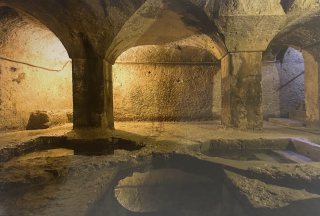
Jewish Ritual Bath (Mikveh)
Ancient Jewish ritual bath carved deep in the rock under a building in Ortigia's old Jewish quarter, shown on guided visits.

Church of San Filippo Apostolo
Church in Ortigia's old Jewish quarter, the Giudecca, with an underground ritual bath beneath it.
Fountain of Arethusa
Freshwater spring on Ortigia's seafront where papyrus grows in a pool, linked in Greek myth to the nymph Arethusa.
Day 2

Sanctuary of the Madonna delle Lacrime
Modern cone-shaped basilica built for an image of the Virgin said to have wept in 1953.

Catacombs of San Giovanni
Large early Christian catacombs beneath the ruined church of San Giovanni, seen on guided visits.

Paolo Orsi Archaeological Museum
One of Italy's leading archaeological museums, with Greek finds from Siracusa and eastern Sicily in a garden setting.
Ear of Dionysius
Tall, ear-shaped artificial cave in an ancient quarry of the Neapolis park, known for its echo.
Greek Theatre of Syracuse
Large 5th-century BC theatre cut into the rock of the Temenite hill, still used for classical plays each summer.
Roman Amphitheatre of Syracuse
Partly rock-cut Roman amphitheatre in the Neapolis park, once used for gladiator shows.

Church of San Martino
Small, very old church in Ortigia with a Gothic portal, near the southern end of the island.

Porta Marina
15th-century Gothic-Catalan gate on Ortigia's harbour side, leading to the seafront promenade.
Lungomare Alfeo
Ortigia's seafront promenade along the Ionian side, good for a walk by the old sea walls with views across the water.
Watch: Siracusa
A one-minute look at the plan: every stop, day by day, with the map.
When to go to Siracusa
Spring and autumn are the best times, warm and sunny without the summer heat, which makes the Neapolis park hard going in July and August. Summer is also the busiest season, and winter is mild with some rain. The classical plays in the Greek Theatre run from May to late June, and the feast of Santa Lucia is held on 13 December.
Plan the rest of your trip
- Where to stay: hotels in Siracusa on Booking.com or Trip.com
- Skip-the-line tickets: museums and sights in Siracusa on Tiqets
- Tours and day trips: things to do in Siracusa on GetYourGuide
- Data on arrival: an eSIM for Italy from Airalo
Some of these are affiliate links: we may earn a small commission at no extra cost to you.
Tips for Siracusa
- The Neapolis Archaeological Park, with the Greek Theatre, the Ear of Dionysius and the Roman Amphitheatre, is best seen early in the day before the heat; there is little shade.
- The Ortigia market near the Temple of Apollo is a morning market, closed on Sundays; go before lunch.
- Santa Lucia alla Badia on Piazza Duomo holds Caravaggio's Burial of Saint Lucy; churches expect covered shoulders and knees.
- Ortigia is compact and walkable, but the Neapolis park and the Paolo Orsi museum are about 2 km north; walk, or take a taxi or local bus.
- In May and June the Greek Theatre stages classical Greek plays in the evening; book tickets ahead, and expect daytime visits to be limited on show days.
Make it your own
Open the guide in Andiamo Places to see every stop on a map with walking directions, move places between days, check opening hours for your dates, and add your own finds. After the trip, your photos become a journal and, if you like, a printed photo book.



Guides are made with the help of AI and public sources such as Wikipedia, and may contain errors. Opening hours and prices change, so check before you go. Spotted a wrong photo, a pin in the wrong place, a missing stop or a better one? Write to andiamotravelapp@gmail.com: the e-mail opens with this guide filled in.
Photo credits
- Bellomo Palace Regional Gallery: sailko, CC BY 2.5
- Castello Maniace: Laurel Lodged, CC BY-SA 3.0
- Catacombs of San Giovanni: FJ78910, CC BY-SA 4.0
- Cathedral of Syracuse: pjt56 —, CC BY-SA 3.0
- Church of San Filippo Apostolo: Ivan Ruggiero, CC BY-SA 4.0
- Church of San Martino: trolvag, CC BY-SA 3.0
- Ear of Dionysius: Michael Wilson from York, United Kingdom, CC BY 2.0
- Fountain of Arethusa: Berthold Werner, CC BY-SA 3.0
- Greek Theatre of Syracuse: fotovideomike from Italia (Michele Ponzio, @michele_ponzio ), CC BY-SA 2.0
- Lungomare Alfeo: Ввласенко, CC BY-SA 3.0
- Ortigia Market: kaempfe.ch, CC BY-SA 2.0
- Palazzo Beneventano del Bosco: pjt56 —, CC BY-SA 3.0
- Palazzo Montalto: sailko, CC BY 2.5
- Paolo Orsi Archaeological Museum: AbelDionis, CC0
- Porta Marina: Bernard Gagnon, CC BY 4.0
- Roman Amphitheatre of Syracuse: trolvag, CC BY-SA 3.0
- Sanctuary of the Madonna delle Lacrime: Simone Tinella, CC BY-SA 4.0
- Santa Lucia alla Badia: Giovanni Dall'Orto, Attribution
- Temple of Apollo: AbelDionis, CC BY 4.0
Opening hours change; check before you go. Map data © OpenStreetMap contributors.
